

IMPRO2 offers 2 different calculators to help you time your investments – the choice is yours, and neither of these represent any investment advice.
Simple Calculator
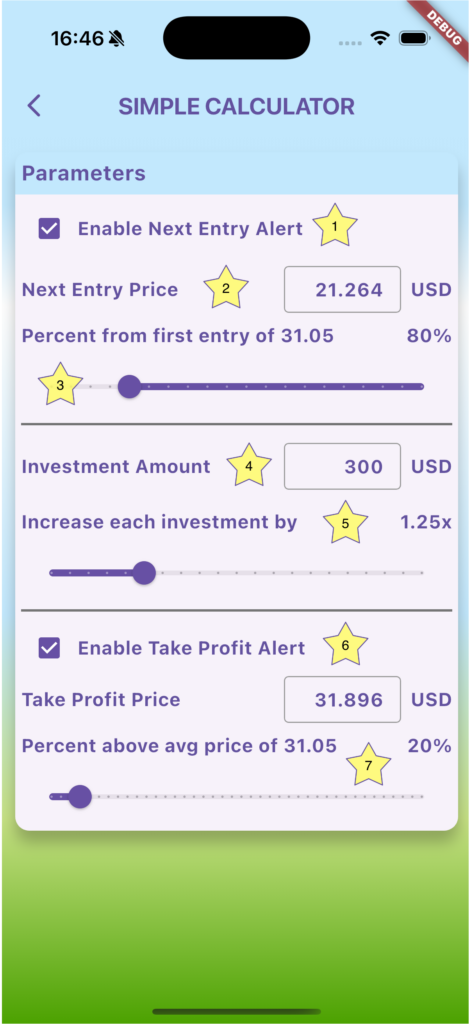
When you enable Next Entry Alert (1), you will see a field where you can enter the price at which you want to be alerted to buy the asset (2). The slider (3) allows you to specify a percentage drop from the current price, or the last price you entered if you already have a buy entry; This may be helpful to you depending on your strategy.
The section underneath can help you if you want to split your investment into several entries. Depending on the total investment you want to make into this strategy (4), and the number of entries (5), it will calculate your first entry amount in quote currency. In this example with 3 investments totalling 300, it would calculate your first entry as 78.69, second as 98.36 (equals 78.69×1.25) and the third one as 122.95 (equals 122.95×1.25).
If you enable Take Profit Alert (6), you can specify a target price level to be alerted to take profit. If you have already made an investment, it will also offer you a slider specifying how many percent above your entry price you want to be alerted (7).
SMMS (‘Smart Modified Martingale Strategy’)
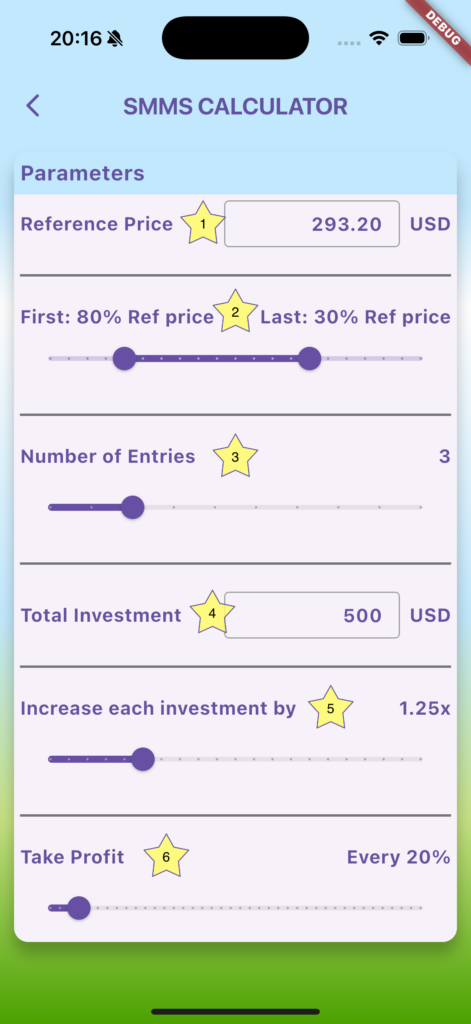
The SMMS calculator works slightly differently. You specify a reference price (by default this will be set to the current price) (1). You then decided on the range of your investments, for example first investment at 80%, and your last investment at 30% of the reference price (2). As with the Simple Calculator, you specify the number of planned entries (3), the total investment (4), and how much you want to increase your investment on each drop (5) (by the way, this increase is a commonly used means to really push your average price down). You can specify at what levels of price increase you want to sell part of your assets (6). The calculator will evenly spread your investments between your first level (80%) and last level (30%), so in this case, with 3 investments, will set an additional alert at 55%.
The principles of this method are mentioned in many investment strategies found online, in one variation or the other. One company who teach a similar method is Investment Mastery, a UK based company with a long track record, whose courses I have attended. You may want to do your own research if you want to learn more about this.